Thursday, March 14, 2019

Are you guilty being judgmental ?

Are you guilty being judgmental ?

No one in this world is perfect. WE ARE HUMAN!!! Surely, we will always make mistakes. To my view, I partially agree that we feel guilty of judging others. Being judgmental has pros and cons simultaneously.  A positive judgment can be done without any sense of prejudice. The motive of positive judgement is giving advice and correcting our mistakes. But, people nowadays like to judge things emotionally without thinking about the consequences rationally. So, I want to share some tips to promote positive judgement.

1. Changing your view to others
·       Oftentimes, people who judge others have strict standards for their own conduct. If you judge someone harshly in a situation, you may have judged yourself as harshly in the same scenario. Bear in mind that other people just like you often make the same error.

2. Expanding your worldwide and knowledge
·       Get involved in activities that can open up your mind. A matured, rational and critical thinking can ensure people that will analyse, interpret and synthesize the suitable judgement with their general knowledge and sense of humanity.

3. Getting rid of your prejudice
·       We should try to figure out the root of their prejudice. If we can figure out the roots of prejudiced thoughts, this can help us to see how they are irrational. When we have deep-seated beliefs about something, we see those prejudiced beliefs actually reflected in innocent actions. In fact, we are projecting our own prejudice.

4. Considering other person’s perspective before judging
·       Everyone has a unique history and personality that affects their behaviors. Before leaping to judge a person’s missteps, we should consider about his / her background and other related aspects.

Don’t judge a book by its cover. Try to be responsible for your judgement. Don’t let your judgement hurt someone who is innocent. Words hurt someone deeply than a knife.
Thank You.

Ancient Chinese Calendar and 24 Seasonal Division Points

Ancient Chinese Calendar and 24 Seasonal Division Points


ANCIENT CHINESE CALENDAR
'Calendar' was the core of ancient astronomy of China and the rudiments of the Chinese calendar was in the Xia Dynasty. The establishment of 'Taichu Calendar' during the reign of Emperor Wudi of Han marked the emergence of the first complete calendar of China. In 1280, the 'Shoushi Calendar' which was made by Guo Shoujing of Yuan Dynasty showcased the summit of the development of the traditional Chinese calendar and was spread and used for more than 360 years. In the 'Shoushi Calendar', a tropical year is 365.2425 days long, which is same as the Gregorian Calendar commonly used in today's world, with only a 26 second error compared with the real time the earth takes to revolve around the sun.

Traditional Chinese calendar is directly related to agricultural production, hence is also known as 'Nong Li'. 'Nong Li' is a literally agricultural calendar which is commonly known as a lunar calendar. It is regulated that a non-leap year contains 12 months with a larger month consisting of 30 days and a smaller one of 29 day. The whole year has 364 or 365 days (the order of the larger and smaller months changes each year). Because each year is about 11 days shorter than a tropical year, 7 leap months are established every 19 years. The added months are called a 'leap month' and the year which contains a leap month is known as a 'leap year'. A leap year has 13 months, totaling 383 or 384 days. This traditional calendar of China is still in use today. Some traditional festivals including the Spring Festival, Dragon Boat Festival and the Mid-autumn Festival are calculated and determined by the traditional Chinese Lunar Calendar.

相關圖片

24 SEASONAL DIVISION POINTS
For the convenient arrangement of agricultural production, ancient Chinese had also created 24 seasonal division points. The 24 seasonal division points indicate 24 different positions of the earth as it revolves around the sun in its annual motion, and is able to satisfactorily indicate the change of seasons and climate. So, the 24 seasonal division points have not only an astronomic significance but play an important role in guiding agricultural production as well.

As early as in the Warring States period, a complete system of 24 seasonal division points had been formed. Starting with Winter Solstice, one seasonal division divisional point will lasts for about 15 days.

24 seasonal division points are listed as below:-
  1. Beginning of Spring
  2. Rain Water
  3. Waking of Insects
  4. Vernal Equinox
  5. Pure Brightness
  6. Grain Rain
  7. Beginning of Summer
  8. Grain Budding
  9. Grain in Ear
  10. Summer Solstice
  11. Sight Heat
  12. Great Heat
  13. Beginning of Autumn
  14. Limit of Heat
  15. White Dew
  16. Autumnal Equinox
  17. Cold Dew
  18. Frost's Descent
  19. Beginning of Winter
  20. Slight Snow
  21. Great Snow
  22. Winter Solstice
  23. Slight Cold 
  24. Great Cold 
24 seasonal division indicate the changes of climate, agricultural activities and natural phenomena in the drainage of the Yellow River throughout the year.

For instance, the Waking of Insects indicates that the snakes and insects have awakened from their dormancy while Grain in Ear indicates that seeds are germinating. 

Besides, different seasonal division points are observed by different customs in China. For example, Chinese will celebrate Qing Ming Festival on the day of Pure Brightness.

Great Contributions to Mathematics

Great Contributions to Mathematics

The Mathematics of ancient China was famous for the accuracy of its calculations. In China, the rudiments of arithmetic can been seen in the Shang and Zhou Dynasties. during the Spring and Autumn Period and the the Waring States Period, the arithmetic of integers and fractions (with addition, subtraction, multiplication and division appearing in the same equation) had been fairly developed. The Mathematics of ancient China used chips as its computing device, employing a decimal numeration system to calculate. The development of this system has made a special contribution to the development of human civilizations.


相關圖片
Chips that were used as counting tool in ancient China Mathematics


DECIMAL SYSTEM

The Chinese invented a 'decimal' numeration system in the Shang Dynasty at the latest. Among the characters on pottery, tortoise shells and animal bones of the Shang Dynasty, we can find that people at that time had already used 13 numbers, namely one, two, three, four. five, six, seven, eight, nine, ten, hundred, thousand and teh=n thousand to numerate any natural number. This was the most advanced and the most reasonable numeration system in the ancient times and had play an immeasurable role to the development of world science and culture.

CHINESE MULTIPLICATION TABLE
The Chinese multiplication table emerging in the Spring and Autumn Period is a perfect combination of the advanced decimal numeration system and Chinese language. As an important method for the popularization and development of Mathematics, it is still in use today. The difference between today's Chinese multiplication table and that of ancient times is that the table of old times started with '9 X 9 = 81' and ended at ' 2 X 2 = 4' while today's table from ' 1 X 1 = 1' to '9 X 9 = 81'.

CIRCUMFERENCE AND DIAMETER OF A CIRCLE

In 263 AD, Liu Hui, a Mathematician invented the division of a circle. He was the first to apply the thought of limits into Mathematical problems and worked out the approximate value of pi as 3.1416. Based Liu Hui's calculation, Zu Chongzhi of the Southern and Northern Dynasties carried out complicated computations concluding that the value of pi falls between 3.1415926 and 3.1415927; that was the most accurate value of pi in the world at that time. Zu took a leading position for advanced in the world and not until more than 1000 year later did the Western scientists catch up to and surpass the achievements of Zu Chongzhi. For the memory of Zu Chongzhi, people call the approximate value that Zu had worked out as 'Zu Chongzhi Ratio'.

相關圖片
Picture of Zu Chongzhi

THE NINE CHAPTERS ON THE MATHEMATICAL ART
The Nine Chapters on Mathematical Art was completed around the first century or so which exerts a very profound influence on the development of Mathematics in ancient China. The book lays out an approach to Mathematics that centers on finding the most general methods of solving practical problems, collecting 246 problems and classifying them into nine chapters. It touches on arithmetic, algebra, geometry and so forth and its records of the solving of multi-variable linear equation group is the earliest in the world which is more than 400 years earlier than in India and more than 1300 years earlier than in Europe. Moreover, its concept of fractions and their operation, its concepts of positive and negative numbers and related addition and subtraction rules, its operation of square roots and its solving of quadratic equations are also the earliest records in the history of Mathematics in the world.

The Nine Chapters on Mathematical Art is one of the world's most recognized Mathematical classics and its emergence marked the preliminary formation of the Mathematical system in China. This book was spread into the Korean Peninsular and Japan as early as in the Sui and Tang Dynasties and now it has been translated into several languages.

相關圖片相關圖片

Abacus and Calculation with an Abacus

Abacus and Calculation with an Abacus


The abacus was a great invention of the laboring people of ancient China. With its simple structure and quick computing method, it is praised as 'the most ancient calculator in the world'.

The abacus was invented on the basis that Chinese used that the counting-rod for a long period. In ancient times, people used small rods to count. Later, with development of productivity and commodity economy, the amount requiring calculation was greater and calculation with counting-rods was limited. Thus, people invented a more advanced counter - the abacus

The abacus is rectangular with a wooden frame on the four sides and small rods fixed inside stringing wooden beads; a beam across the middle separates the abacus into two parts: each rod has two beads on its upper deck, each representing one. The extant abacuses vary in shape; the most commonly seen have two beads in the upper part and five in the lower parts. Moreover, some have one bead in the upper part and five beads in the lower part or one bead in the upper part and four beads in the lower part. Particularly, the Museum of Chinese History houses an abacus from the Qing Dynasty which was excavated in Guangdong and has two beads in the upper part and six beads in the lower part. Such a style of abacus is seldom seen.

Calculation done by way of the abacus is called 'abacus calculation'. Abacus calculation has its own rules of 'addition, subtraction, multiplication and division' which are called the rules of abacus calculation in general. For ordinary counting, skillful abacus calculation is not inferior to computer, especially in additive and subtractive calculation. After abacuses replaced counting chips and became the major counting devices of the Chinese society in the Ming Dynasty (1368-1644 AD), their use had played an immeasurable role in accelerating economic development and pushing forward scientific and technological progress. Furthermore, the abacus gradually spread into Korea, Japan, America, Singapore, Malaysia and other countries and regions becoming an important component of world culture.

With the rapid development of electronic calculators, abacuses gradually lose their calculating role in social life and production, but the abacus-based mental arithmetic which is based on traditional abacuses have been given much importance because of its unique function in intelligence development.

「abacus」的圖片搜尋結果

Unique Tradition Chinese Medical Science

Unique Tradition Chinese Medical Science

Traditional Chinese medicine is a systematic science which is particularly concerned with wholeness and carries a unique theory. Its theoretic system was largely formed in the Spring and Autumn Period and the Warring States Period and was constantly developed and improved afterwards. It is not only a precious piece of legacy in the history of Chinese culture but has made enormous contributions to the development of world of medicine.

Traditional Chinese medicine views the human body as a part of nature as a whole. In treatment, it not only takes into account the human body itself but pays much attention to the relations of diseases to the patient's psychology and living habits and to the outside environment, especially to climatic changes and then carries out all-round analysis and treatment in reference to the causes and symptoms of the diseases of the patient. 

The Canon of Medicine of the Yellow Emperor which occurred in the Warring States Period, is the earliest extant medical experience in and before the Spring and Autumn and the Warring State periods (770-221 BC), laying a theoretical foundation for traditional Chinese medical science. The Febrile and other Diseases which was written by Zhang Zhongjing, a renowned doctor of the Eastern Han Dynasty, is one of the most influential works in the history of traditional Chinese medicine. Hua Tuo, a reputed doctor of the Eastern Han Dynasty was the first in world to use anesthetic (Mafeisan) in surgery and was called the 'founder of surgery'

THE TRADITIONAL DIAGNOSING METHODS OF CHINESE MEDICINE

相關圖片

1. Observation
  • To observe the appearance of the patient
  • Example : His countenance and the sign of his vigor or lack of vigor
2. Auscultation and olfaction
  • Listening to the sounds and smells let out by the patient
3. Interrogation
  • To enquire about the course of disease and the status quo of the patient
4. Pulse feeling and palpation
  • Involve inspection of the patient's pulse
  • Bian Que, a famous doctor of the Warring States Period who is reputed to be the 'founder of Chinese medicine' was especially good at it
  • The application of pulse feeling and palpation indicates that the physicians of ancient China had grasped the relationships between pulse and each part of human body.
TRADITIONAL CHINESE MEDICINE
Traditional Chinese medicine mainly come from plants, animals and minerals. These medicines not only enrich the world medical system, but are widely used in the field of regimen and cosmetology. There were many monographs about medicines and prescriptions in ancient China. For example, the Essential Formulas for Emergencies [Worth] a thousand Pieces of Gold compiled by Sun Simiao of the Tang Dynasty collects more than 6500 prescriptions and has been praised as an 'encyclopedia of clinical medicine' and the Compendium of Materia Medica written by Li Shizhen of the Ming Dynasty (1368-1644 AD) includes 1892 medicines, 1109 illustrations and 11096 prescriptions, quite deserving to be called a complete collection of medicines in the ancient world.

相關圖片
Chinese Traditional Medicine

The Origin and Evolution of Chinese Characters

The Origin and Evolution of Chinese Characters

Chinese characters constitute one of mankind's oldest systems of scripts in the world. Total Chinese characters are more than 80000 which are consisting up to 3500 commonly used and convey 99% of social information.

「汉字的演变」的圖片搜尋結果

THE EVOLUTION OF CHINESE CHARACTERS
Chinese characters originate from pictures and pictographic signs in primitive society which were created and summarized step by step over a long period of labor and pratice by the ancestors. Through evolvement, mature jiaguwen (oracle scripts or Chinese scripts carved on tortoise shells or animal bones) appeared in the Shang Dynasty 3000 years ago at the least.

1. Jiaguwen

  • Jiaguwen are Chinese scripts carved on tortoise shells or animal bones, mainly during the Shang Dynasty (17th - 11th BC). 
  • Jiaguwen have regular strokes and beautiful form, which is evidence that they had undergone a long development process and that there should be certain rudiments preexisting jiaguwen.
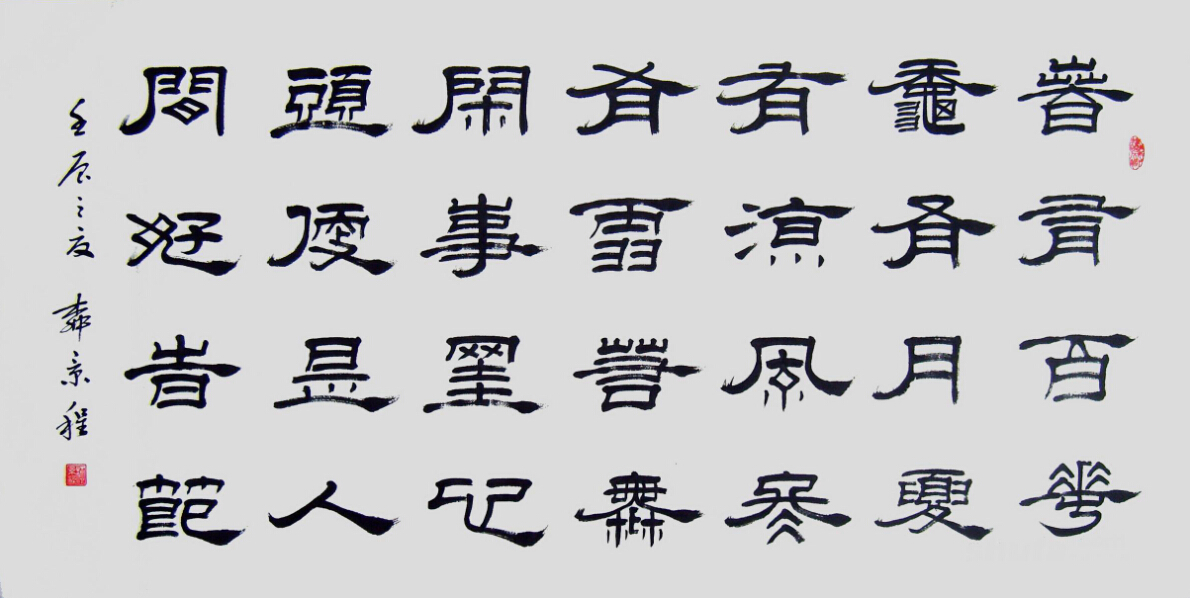
  • From jiaguwen to the current simplified Chinese characters, Chinese characters have experienced a course of evolution from hieroglyph to abstraction and from complexity to simplicity, evolving from jiaguwen to jinwen (ancient Chinese script used in inscriptions on ancient bronze objects), zhuanshu (seal characters), lishu (official script) and kaishu (regular script) as well as caoshu (cursive script) and xingshu (semi-cursive script)
相關圖片

2. Jinwen
  • Jinwen also known as 'zhonhgdingwen'. are script forged or carved on bronze ware in ancient times and their forms are fuller, rounder, more upright, more squared and better balanced in structure compared with jiaguwen. Jinwen existed in Shang, Zhou, Qin and Han dynasties.


3. Zhuanshu

  • Zhuanshu can be divided into dazhuan (large seal script) and xiaozhuan (small seal script).
  • Dazhuan also called zhouwen, usually refers to the script of the State of Qin during the Spring and Autumn Period and the Warring States Period, and the most typical dazhuan was shiguwen; xiaozhuan was a result of simplified dazhuan, but was better balanced in structure and more rgular, with simplified, rounder and smoother strokes.


4. Lishu
  • Lishu can be divided into Qin li and Han li. Qin li was used in the Qin Dynasty. 
  • Han Li also known as 'present li' was derived from Qin li and commonly used in the Han Dynasty.
  • Compared with Qin li, Han li had fewer traces of zhuanshu.
「隶书」的圖片搜尋結果

5. Kaishu
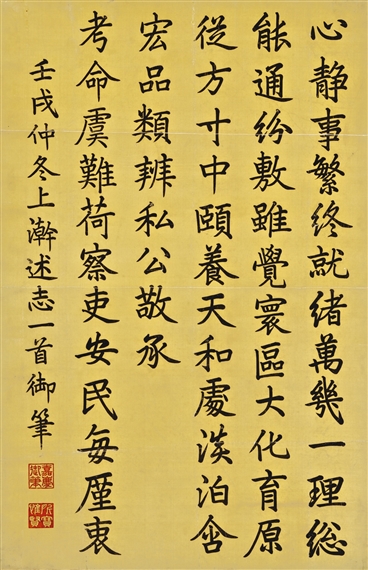
  • Kaishu was developed on the basis of lishu, first appearing in the late Han Dynasty and most popular in the Wei and Jin Dynasties.
  • Being egular and square in forms and simple in writing, it is still in use today.
  • It is a standard script that has been used for the longest duration.
「kaishu」的圖片搜尋結果

Jiaguwen, jinwen, zhuanshu, lishu and kaishu were or are scripts formally used in certain periods of history while caoshu and xingshu have been auxiliary ones all the time. Caoshu features in general continuous or omitted strokes. Xingshu originated in the late Eastern Han Dynasty and is a kind of script between kaishu and caoshu. Despite of its continuous strokes, it is easy to write and read and thus very practical.

Panduan untuk Mengurangkan Hutang

Panduan untuk Mengurangkan Hutang


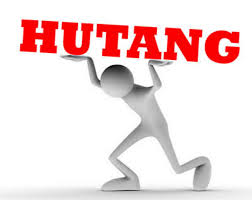
Hutang merupakan beban dalam kehidupan yang perlu diselesaikam demi menjamin kemaslahatan hidup. Secara tidak langsungnya, hutang akan menyebabkan seseorang individu menghadapi tekanan emosi sekiranya hutang tidak diuruskan dengan betul. Keadaan ini akan menjadi lebih truk lagi apabila masalah hutang berlaku dalam isu rumah. Terdapat beberapa cara yang pragmatik untuk menyelesaikan masalah hutang dalam isu rumah. 

1. Menyelesaikan hutang yang sedia ada dan tidak membuat hutang yang baru
            Kita perlu mengenal pasti hutang yang sedia ada terlebih dahulu sebelum menyusun strategi untuk menjelaskan komponen-komponen hutang yang ditanggung. Kita perlu menganalisa dan mengirakan jumlah faedah yang perlu dibayar untuk menjelaskan sesuatu hutang tersebut. Pada lumrahnya, hutang yang dikenakan kadar faedah yang paling tinggi seperti hutang kad kredit perlu dilunaskan dengan lebih cepat berbanding dengan hutang yang lain seperti pinjaman untuk membeli rumah atau overdraf. Hal ini demikian kerana kegagalan untuk menjelaskan hutang kad kredit dalam tempoh masa tertentu akan dikenakan caj tambahan atas kelewatan tersebut. Hutang yang dikenakan kadar faedah yang tinggi akan meningkatkan lagi jumlah bayaran pokok dan bayaran faedah semasa sesuatu hutang tersebut dijelaskan. Kita seharusnya menggunakan sumber kewangan yang sedia ada dengan maksimum untuk menyelesaikan hutang yang ditanggung berbanding dengan cara membuat pinjaman yang baru seolah-olahnya untuk menjelaskan hutang yang terdahulu.

Membayar hutang mengikuti tempoh yang telah ditetapkan
            Kita perlu membayar pinjaman atau melunaskan hutang apabila sudah samapai tarikh matang. Hal in demikian kerana kita akan dikenakan caj lebihan sebagai denda sekiranya kita dapat menjelaskan hutang pada tarikh yang telah pun ditetapkan. Sehubungan dengan itu, kita bukan sahaja perlu menanggung caj lebihan tersebut, malahan rekod pembayaran tersebut akan dihantar oleh bank atau institusi kewangan tersebut kepada Bank Negara Malaysia. Hal ini akan secara tidak langsung akan mencemarkan reputasi kita dan kemungkinan besar kita akan menghadapi kesusahan untuk membuat pinjaman semula dengan bank atau institusi kewangan yang sama atau yang lain. Sekiranya jumlah hutang yang ditanggungkan oleh seseorang itu melebihi RM30000 dan tidak dilunaskan mengikut ketepatan pihak pemiutang, maka seseorang itu akan dikenakan tindakan undang-undang dan berakhir dengan kebankrapan. Hal ini sudah pastilah akan menjejaskan lagi profil peribadi dan kemungkinan besar akan diberhentikan kerja serta-merta.

2. Amalan menabung
      Pendidikan kewangan peribadi menumpukan kepada aspek keperluan seseorang untuk mengamalkan tabiat menyimpan atau menabung. Tabiat mulia ini bertujuan untuk menggalakkan orang ramai untuk menyimpan dan menabung secaranya amnya demi penggunaan atau perbelanjaan pada masa hadapan atau pada saat-saat berlakunya kecemasan. Dengan adanya sejumlah simpanan, kita tidak perlu tergesa-gesa untuk mencari sumber-sumber lain untuk membayai sesuatu perbelanjaan. Misalnya, kita tidak perlu membuat pinjaman atau berhutang dengan institusi-institusi kewangan atau terpaksa menjual harta atau aset-aset yang lain semata-mata untuk memenuhi keperluan perbelanjaan yang mendesak atau kecemasan. Amalan menabung juga boleh membantu kita untuk membina kekayaan di mana kita boleh memanfaatkan sebahagian daripada hasil tabungan tersebut untuk membuat pelaburan yang menjaminkan hasil yang positif dengan mengambil kira risiko-risiko seperti kemelesetan ekonomi, inflasi, ketidakstabilan dan sebagainya

Membezakan antara barang keperluan atau kehendak
           Konsep asas dalam belanjawan ialah konsep kehendak dan kemahuan. Keperluan ialah sesuatu diperlukan untuk hidup seperti air dan makanan. Manakala kehendak pula keinginan terhadap sesuatu tetapi kita masih boleh hidup tanpanya. Antara contohnya ialah menonton wayang, melancong, hiburan dan barang mewah.

3. Menyediakan bajet atau belanjawan terlebih dahulu sebelum berbelanja
            Konsep yang amat signifikan dan perlu dipegang semasa menyediakan bajet ialah kita perlu membezakan antara barang keperluan dengan barang kehendak. Barang keperluan merupakan barangan yang diperlukan oleh kita untuk meneruskan hidup seperti air dan makanan. Manakala, barang kehendak merupakan barangan yang dapat memenuhi keinginan and nafsu kita untuk tujuan keselesaan seperti barangan mewah, melancong, telefon bimbit yang berjenama dan sebagainya. Kita juga menyediakan senarai barang yang hendak dibeli selepas pergi pusat beli-belah atau pasar raya. Senarai tersebut hanya mengandungi barangan keperluan yang perlu dibeli sahaja. Seterusnya, kita akan membeli barangan yang disenaraikan terlebih dahulu sahaja. ‘Window shopping’ akan menyebabkan pembaziran dan keborosan dalam perbelanjaan. Jadi, kita perlu mengamalkan tabiat berbelanja secara berhemat iaitu mengikut kemampuan kita dan tidak berbelanja melebihi pendapatan.

4. Mempelajari ilmu pengetahuan tentang pengurusan kewangan
            Penyediaan bajet atau belanjawan merupakan kaedah paling efisien dalam pengurusan kewangan. Dalam proses penyediaan bajet, seseorang perlu mengetahui cara dan ilmu tentang pengurusan kewangan perlu dipelajari. Pengetahuan mengenai pengurusan kewangan membolehkan membuat keputusan kewangan yang baik dan bijak. Pengetahuan tentang pengurusan kewangan boleh diperolehi melalui pendidikan kewangan yng dianjurkan oleh persatuan-persatuan pengguna, internet, laman sesawang, institusi kewangan dan agensi-agensi lain yang berkaitan. Tambahan pula, buku-buku dan jurnal-jurnal tentang pengurusan kewangan juga boleh didapati dengan mudah. Antara laman sesawang yang mendedahkan pendidikan tentang pengurusan kewangan atau program pendidikan pengguna ialah bnm.gov.my/consumeralert, akpk.org.my, bankinginfo.com.my, insuransinfo.com.my serta Islamicfinance info.com.my. Sehubungan dengan itu, penyertaan program-program tersebut akan menambahkan lagi maklumat, ilmu pengetahuan dan kefahaman kita tentang pengurusan kewangan peribadi dan isi rumah yang lebih strategik. Selain itu, terdapat juga laman sesawang yang memberi khidmat nasihat tentang produk serta perkhidmatan yang didesediakan oleh institusi perbankan, insurans ataupun Takaful. Misalnya, laman sesawang bankinginfo.com.my telah menunjukkan perbandingan antara fi dengan caj yang akan dikenakan oleh institusi-institusi kewangan. Portal rasmi Bank Negara Malaysia juga memberi peringatan serta nasihat kepada para pengguna supaya berhati-hati dalam membuat keputusan untuk mendapatkan perkhidmatan kewangan yang ditawarkan oleh pihak atau institusi kewangan yang tidak berlesen.

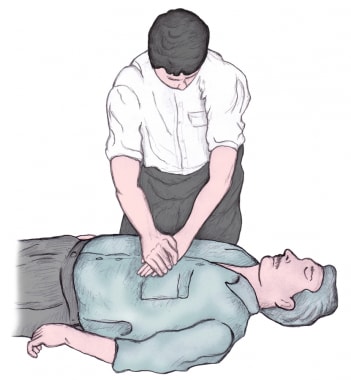
Cardio-Pulmonary Resuscitation (CPR) - Part 1: Introduction

Cardio-Pulmonary Resuscitation (CPR) - Part 1: Introduction CARDIO-PULMONARY RESUSCITATION (CPR) Cardio-Pulmonary Resuscitation (CPR...