Showing posts with label Arts and Crafts. Show all posts

Thursday, March 14, 2019

Chinese Knotting

Chinese Knotting


At the beginning, the practice of tying knots proceeded from production and daily life needs. The typing of knots was a laboring skill, such as in tying objects and weaving fishing nets; meanwhile, it was a method for assisting memory. Before the invention of characters or letters, people represent different things using knots of varying sizes and shapes.

The well-developed knotting skills of ancient China were directly related to the extensive use of knots in people's daily life. Traditional Chinese costumes are mainly tied with belts and the wearing of jade ornaments has been popular in the Chinese society; these two have also help to improve the development of knotting skills. In addition, many articles of everyday use, such as window curtains, bed curtains, flutes, sachets, tobacco bags and fans, have to be fixed or decorated with knots, or kept contained with knots. Therefore, Chinese knotting was an important skill that Chinese women required to grasp in ancient times, and some related customs were even formed. For example, before Duanwu Festival, women knitted many 'longevity plaits' with five-coloured threads and presented them to relatives and friends on the Festival. It is said that such plaits tied to one's wrists could prevent wicked things and diseases.

相關圖片

Chinese knotting is different from the knotting methods of other ethnic groups mainly in the following aspects:-
  • Chinese knots are woven with one single strand
  • Tight and complicated in structure
  • Do not become loose easily
  • Very practical in use
  • Symmetrical with both left and right sides and front and 
  • Symmetrical with both front and reverse sides
  • Confirming to the traditional Chinese habit and aesthetic view of decoration
  • Weaving methods of many basic knots can be combined together to indicate strong changeability and decorative
Chinese knots have a wide range of patterns, including true love knots, panchang knots, wanzi knots and wintersweet knots. These patterns are not only exquisite and beautiful, but also carry auspicious and celebrative meanings. One example is true love knots which use two coloured strands tangled together. In the weedings of ancient times, true love knots were used in many ceremonies between bride and bridegroom. True love knots are often used to express love. It said that Su Xiaoxiao, a beauty of the Qi Dynasty (479-502 AD), once came across a man and fell in love with him while taking a ride outdoors. She wrote a poem to express her eelings, writing "Where to make our truelove knots? "

In the 1980s and 1990s, Chinese knots were in vogue both in China and among overseas Chinese, thus becoming craft works full of the characteristics of Chinese culture.

Four Treasures of Study in Ancient China

Four Treasures of Study in Ancient China


In ancient China, brush pens, Chinese ink, paper and ink stone were four necessary tools in writing or painting. In the Song Dynasty, the began to be called ''four treasures of study''. They are stationary for practical uses, but as exquisite products, they can often be viewed as craft works and listed into the collection. The ''four treasures of study'' have a great number of varieties, and the best-known ones are Chinese brush of Huzhou, ink stick of Anhui, paper of Xuancheng and ink stone of Duanzhou.

1. Brush pen
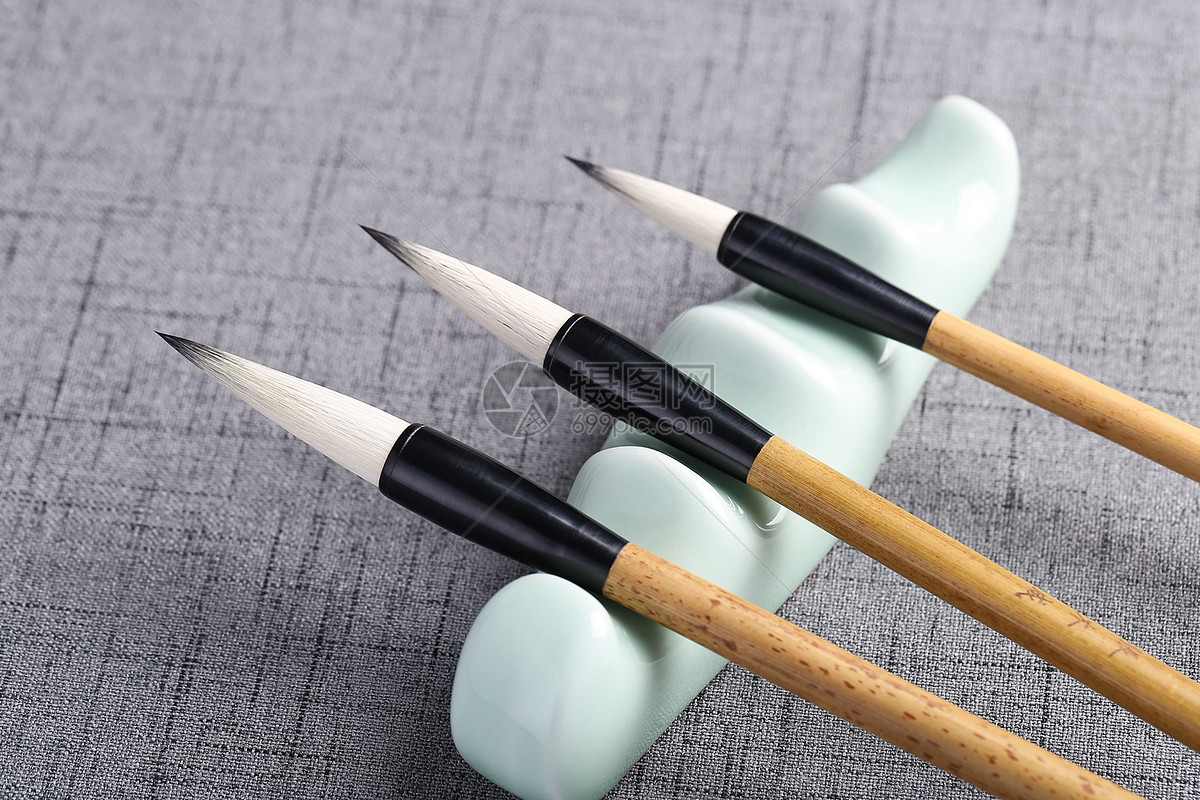
Brush pens have the longest history among the ''four treasures of study'' and are made primarily of small bamboo pipes and hair from beasts. Those made of the hair of goats, hares and weasels are most commonly seen, and are respectively called ''yanghao'' (goats' hair), ''tuhao'' (hares' hair) and ''langhao'' (weasels' hair). Brush pens manufactured in Huzhou of Zhejiang Province are made of carefully selected hair and the tips of the pens are prefectly round and even. Therefore, they are flexible and springy in use.

相關圖片


2. Chinese Ink
Chinese ink sticks are typically made of the soot of pines. When producing pine soot ink, pine wood is lit but prevented from fully burning. In this way, it will emit black soot which later turns into very tiny black powder after it cools down. The ink sticks produced in Shexian County of Anhui Provinece have enjoyed a good reputation since the Tang and Song Dynasties. The top quality pine wood and spring water in this area provide the best raw materials for the production of Chinese ink sticks. The ink stick of Anhui is hard and emits fragrance and feels smooth in writing.

「中国墨汁」的圖片搜尋結果


3. Xuan Paper
Xuan paper is produced in Jingxian County of Anhui and other places. Xuan paper is white, refined, even, soft, resilient and absorbent and does not change in color. As the material of writing and painting. Xuan paper is more age-resistant than silk and can be preserved for a long time without fading in colour. Many ancient calligraphic works and traditional Chinese paintings, including the Five Oxen painted by Han Huang of the Tang Dynasty and housed by the Imperial Palace Museum of Beijing, have been painted on Xuan paper. It deserves its reputation of ''endurance for thousands of years".
「宣纸」的圖片搜尋結果

4. Ink Stone
As tools for grinding ink sticks, ink stones are made of jade, raw lacquer, pottery, stones, copper, iron and so on and mainly of stones. In China, there are four most famous kinds of ink stones, namely Duan ink stones, She ink stones, Tao ink stones and Chengni ink stones. The former three are made of stones and the last is made of pottery. Duan ink stones are produced in Zhaoqing, Guangdong Province. They have abundent textures, feel warm and moist like jade and do not harm the hair of brush pens and the ink ground with them does not easily dry up. She ink stones are produced in Shexian County, Anhui, appearing beautiful and elegant in shape.

Zhi Yuan (Chinese Traditional Kite)

Zhi Yuan (Chinese Traditional Kite)


It is said that in the Warring States Period (more than 2000 years ago), a philosopher named Mozi spent three years making a flying bird with bamboo and wood. A well-known ingenious carpenter, Lu Ban carried down this technique. The wooden bird that he made could fly for three days.

For the real origin of kite, experts on folklore hold that they might be invented when the ancient people flew kites on the Pure Brightness Festival (Qing Ming) to commemorate their dead relatives and friends. Kites were mostly used in military affairs in their early stage. According to history, a general of the Tang Dynasty was once besieged in a town. He ordered people to make a huge paper kite and hide a letter for help inside. When the kite was successfully flown, reinforcements arrived in time for the, to win the battle. In the Tang Dynasty, kites imitating the shapes of animals and plants and those emitting sounds emerged, and the major function of kite turned to entertainment. During the Five Dynasty Period (907-960 AD), a man named Li Ye placed a flute-like device on the kite to make more melodious sounds. In the Song and Yuan dynasties, kites were introduced into Tibet, Yunnan and northern China which are inhabited by the minority ethnics.

The renowed places producing kites in China today are Beijing, Tianjin, Nantong of Jiangsu Province and Yangjiang of Guangdong Province. In the process of making a kite, a frame is first made with bamboo strips and is then covered with paper or silk. The making of kites requires considerable skill, so does kit-flying: only in this way can kites fly freely and steadily in the sky. Folk craftsmen with great skill can makes kites in the shape of human figures, animal or auspicious designs. For example, a kite imitating the shape of a centipede is supposed to raise its head up when it flies in the sky, a dragon-shaped kite should be able to move to and fro and a kite in the shape of an eagle is expected to hover.

Chinese people like to fly kite in open fields in the spring. They can breath fresh air, exercise their bodies and lighten their hearts. Traditional Chinese medicine even holds that to walk with the upward when flying a kite is physically and psychologically beneficial sport and an interesting game, hanging a kite on a wall for decoration is apiece of craft work that pleases both the eye and mind.

In recent years, a large-scaled international kite festival has been held annually in Weifang of Shangdong Provience.

「Shandong Weifang International Kite Festival」的圖片搜尋結果
Shandong Weifang International Kite Festival

Paper Cutting

Paper Cutting


Paper Cutting of China has a history of more than 2000 years, becoming a trade in the Song Dynasty; those with great skill are even able to cut exquisite Chinese characters and flowers in sleeves.

Paper Cutting can be divided into two types: One uses scissors, and the other uses cutters. Because they have very similar artistic characteristics, they are both called 'paper cutting'. In cutting out a pattern on a piece of paper, the paper must be stenciled, and the lines are expected to connect with each other, Such a stencil processing results in two kinds of effects: either with the lines of the pattern linking with each other, or the lines of the pattern being vacant spaces, with the left paper still in a single. The former is known as 'yang ke' and the latter 'yin ke'.

Specific tools and raw materials determine the shaping traits of paper cuts. It cannot depict things in detail as painting does, instead, it is meant to highlight the vivid contour characteristics as a whole and lay an emphasis on the expression of spiritual meanings. For example, window decoration paper cut themed with a rooster can present the vigorous and martial posture of a rooster only by means of its contour such as its highly raised comb,turn up tail and powerful claws. And a few points, lines and saw tooth patterns on the body of the rooster precisely show the tactile feeling of its feathers.
「chinese paper cutting rooster」的圖片搜尋結果

Paper cutting mostly employs plane designs and avoids the overlap of layers. Paper cuts often adopt symmetrical structures. In the process, a piece of paper is folded back and one half of the pattern is cut out. When it is unfolded, a complete paper cut with two symmetrical halves appears. Paper cutting mainly makes use of mono-colored paper, such as scarlet, orange, yellow and green and sometimes it is dyed after the cutting. In some cases, to meet a special requirement and pursue magnificence, thin pieces made of gold and silver or paper sparkled with golden and silvery powder are used.

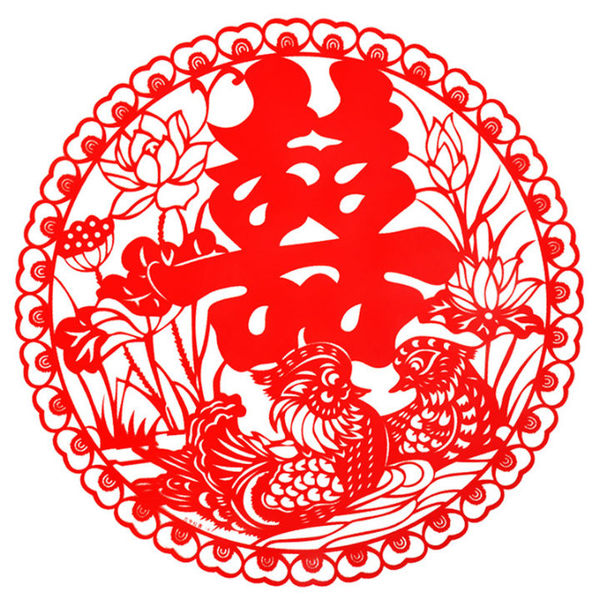
Paper cutting is a folk craft and paper cuts have a wide range of uses in folk circles. Now, they usually celebrative patterns in various colors, used to decorate furniture and utensils on the occasion of festivals and weddings. For example, Chinese people like to cut window decorations with red paper showing the design of '囍' at a wedding. In the addition, paper cuts are often used as a model in embroidery, and they have rheir wonderful use in the technique of pottery, lanterns and fan decoration.
「囍」的圖片搜尋結果


Famous paper cuts in China include the window decorations in Shaanxi, the operatic figures in Yuxian County, Hebei and the models for embroidery among the minority ethnic groups in the south.

相關圖片

Leather-silhouette Show and Puppet Show

Leather-silhouette Show and Puppet Show


Puppet shows are an operatic form in which performers stand behind the curtains and pull wires on wooden puppets to make them move. In accordance with structure of puppets and the manipulation methods of performers, it can be divided into wire-hanging puppet show, stick-supporting puppet and glove puppet show.

In a wire hanging puppet show. threads are tied onto the important joint parts of a puppet such as the head, the back, the arms and the palms and a performer manipulates the puppet by pulling the thread. For the stick-supporting puppet, manipulating sticks are installed on a puppet's head and hands. with the stick at the head as the major one and those on the hands as auxiliary ones. In a performance, the performers hold the sticks with their hands, raising the puppets to control their various motions. And for gloves puppets, a cloth bag is sewed below the neck of a puppet to connect its limbs and a performer puts his hand into the bag to control the puppet for different actions.

The art of puppetry has a long history in ancient China. The performance of puppet acrobatics can date back to the Three Kingdoms Period and puppet shows began to be used to present stories in the Sui Dynasty. Since the 20th century, puppet shows have evolved to include an increasing number of performance types. For example, being that the performers enter the stage from behind the curtain with real persons and puppets performing together on the same stage. The repertoire of puppet shows is also on the rise. After 1930s, puppet shows began to be adapted for films and TV shows.

Leather-silhouette is a general term both for leather-silhouette shows and characters who appear in such shows (including related props and the other stage objects). As its name shows, leather-silhouette is made of leather; for the sake of durability and transparency, the best raw material is donkey and ox skins. Therefore, it is also known as 'donkey leather silhouette'. Such leather is painted with transparent red, yellow, green and black colours to refer it is cut into certain designs. These special materials and colours make the shadow of leather figures and props beautiful and transparent when it is cast onto a backlit cloth screen.

Leather-silhouette figures are also divided into the roles of sheng, dan, jing and chou. Each figure is composed of the head, the upper body, the lower body and the hands which are tied together. Performers control sticks at the neck and hands of the figure to make a range of expressive motions.

Leather-silhouette shows are a comprehensive folk art, involving the cutting of leather figures and props, dyeing, the manipulation of such figures in performance, singing and accompanying music,etc. It is extensively spread throughout China and was once a significant entertainment form for ordinary people. Influenced by local customs, leather-silhouette shows vary from one place to another in the cutting of leather figures, vocal tunes and performance patterns. Therefore, they have formed different genres with the most famous forms on leather-silhouette originating from Shanxi, Hebei and Zhejiang.

Chinese Traditional Fan

First Aid Kit (Part 1)


FIRST AID KIT
  • All workplaces, leisure centers, cars and homes should have first aid kits.
  • First aid kits for workplaces or public places must conform to legal requirements and be clearly marked in a white box with a green cross or a red box with a white cross and easily accessible.
  • Home is the place that we often spend our time other than our workplaces, officers and other venues.
  • Many unwanted accidents happened in our home due to our carelessness. For example, we accidentally cut our fingers when preparing meal in kitchen.
  • So, there is a must for us to prepare a first aid kit in home for our own safety. If any accidents happened, we can use the content in first aid kit to treat our wound to prevent the situation from deteriorating.
  • We can actually buy a kit or put together first aid items by ourselves and keep those first aid items in a clean, waterproof container.
  • Any first aid kit must be kept in a dry place, and checked and replenished regularly.
  • We can also add pain-relief tablets such as paracetamol in first aid kit


「first aid kit」的圖片搜尋結果

CONTENT OF FIRST AID KIT
  1. Yellow solution
  2. Savlon
  3. Adhesive dressings / plasters
  4. Triangular bandage
  5. Crepe bandage
  6. Roller bandage
  7. Cotton Ball
  8. Gauze pad
  9. Disposable gloves
  10. Forceps
  11. Scissors

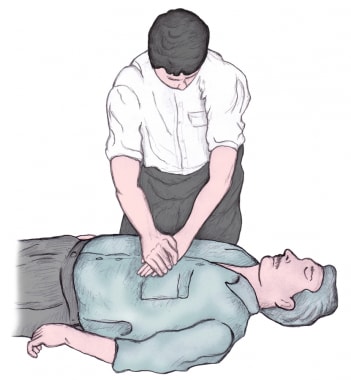
Cardio-Pulmonary Resuscitation (CPR) - Part 1: Introduction

Cardio-Pulmonary Resuscitation (CPR) - Part 1: Introduction CARDIO-PULMONARY RESUSCITATION (CPR) Cardio-Pulmonary Resuscitation (CPR...