Showing posts with label CPR. Show all posts

Wednesday, March 27, 2019

Cardio-Pulmonary Resuscitation (CPR) - Part 1: Introduction

Cardio-Pulmonary Resuscitation (CPR) - Part 1: Introduction


CARDIO-PULMONARY RESUSCITATION (CPR)
Cardio-Pulmonary Resuscitation (CPR) is a lifesaving technique useful in many emergencies, including a heart attack or near drowning, in which someone's breathing or heartbeat has stopped.
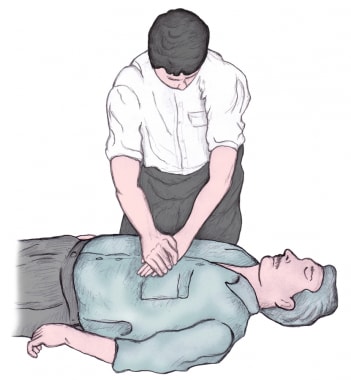
「cpr」的圖片搜尋結果


WHY SHOULD EVERYONE LEARN CPR?
Acute heart disease causing unexpected heart arrest is the most frequent single killer in our society. In addition, breathing and heart arrest are the immediate causes of dearth in a large number of accidents.

Substantial proportion of these deaths could be prevented if:

  • Cardio-Pulmonary Resuscitation (CPR) is started immediately by a trained bystander in order to preserve vital functions
  • Emergency medical treatment becomes quickly available in order to restore spontaneous heartbeat and breathing
Although qualified medical personnel may be on the spot relatively early, their efforts are too often in vain as nobody has been providing basic life support during the very first and most crucial minutes.

So that a trained bystander is available to perform CPR when arrest occurs, as many as possible of the teachable population should be motivated and trained to perform the relatively simple techniques of CPR.

WHY SHOULD YOU LEARN CPR?
Perhaps some one you love is suffering from heart disease. Maybe the nature of your job requires that you prepared to handle medical emergencies. Or you may believe, as many people do, that knowing the skills of CPR simply makes you a more useful member of  your community.

Whatever your reasons, it is important to remember that CPR can help to save lives. Your hard work and study can make a difference.

LEGAL CONSIDERATIONS IN USA
Recognition is given for successful completion of a CPR course, which includes passing written and performance examinations based on criteria established by the the American Heart Association. It does not imply licensure or warrant future performance.

There was no instance known which a layperson that has performed CPR has been sued successfully. There are 'Good Samaritan' Laws in many states that specifically protect professionals and laypersons performing CPR 'in good faith'. Under most Good Samaritan Laws, laypersons are protected if they performed CPR even if there have no formal training.

All the citizens who are able to learn and perform CPR, if such performance would not pose a medical or psycho-emotional danger to themselves, should learn to perform CPR well enough to sustain the life of the victim until professional emergency medical treatment becomes available.

As a rescuer acting a good faith, you should remember that one CPR is begun, you may stop only when:
  • The victim recovers (regains breathing or movement)
  • Another trained individual takes over
  • You are too exhausted to continue
COMMON CAUSES OF SUDDEN DEATH
  • Cardiac Arrest
  • Electric Shock
  • Drowning
  • Drug Overdose / Drug Abuse
  • Suffocation
  • Severe Allergic Reaction
  • Trauma
  • Stroke

Thursday, March 14, 2019

Cardio-Pulmonary Resuscitation (CPR) - Part 2: CPR for an adult

Cardio-Pulmonary Resuscitation (CPR) - Part 2: CPR for an adult


It's far better to do something than to do nothing at all if you are fearful that your knowledge or abilities are not sufficient enough. Remember, the difference between your doing something and doing nothing could be someone's life.

Here is advice from the American Heart Association:

  • Untrained. If you are not trained in CPR, then provided hands-only CPR. That means uninterrupted chest compression of 100 to 120 a minute until the paramedics arrive. You don't need to try rescue breathing.
  • Trained and ready to do so. If you're well-trained and confident in your ability, check to see if there is a pulse and breathing. If there is a pulse and breathing. If there is no breathing or pulse within 10 seconds, begin chest compression. Start CPR with 30 chest compression before giving two rescue breaths.
  • Trained but rusty. If you have previously received CPR training but you are not confident in your abilities, then just do chest compression at a rate of 100 to 120 a minute.
The above advice applies to adults, children and infants needing CPR, but not newborns (infants up to 4 weeks old).

CPR can keep oxygenated blood flowing to the brain and other vital organs until more definitive medical treatment can restore a normal heart rhythm.

When the heart stops, the lack of oxygenated blood can cause brain damage in only a few minutes. A person may die within 8 to 10 minutes.

To learn CPR properly, take an accredited first-aid training course, including CPR and how to use an Automated External Defibrillator (AED). If you are untrained and have immediate access to a phone, call 911 or your local emergency number before beginning CPR. The dispatcher can instruct you in the proper procedures until help arrives.

CPR GUARD LINE 2010

  • A compression rate of at least 100 per min
  • At least 5 cm (2.5 inch) for chest compression depth
  • Push hard and fast
  • Chest must fully recoil before next compression
  • One complete cycle: 30 chest compression to 2 rescue breath
  • Each ventilation must over 1 second, just enough to see chest rise
  • Call for help
STEPS TO DO CPR 
  1. Danger
  2. Response
  3. Compression / Circulation
  4. Airway
  5. Breathing
1. DANGER
  • Before doing CPR, we must make sure that surrounding are safe and no danger will harm the casualty.
  • Ask for help (Call 990 for the ambulance)
2. RESPONSE
  • Check for the casualty's response to command, touch and pain
  • Casualty may response by eye movement, movement or show verbal response
  • The level of responsiveness (Conscious to Unconscious):-
    • Alert
    • Voice 
    • Pain
    • Unconscious
  • If the casualty is unconscious, start the chest compression.
3. COMPRESSION
  • Put the person on his or her back on a firm surface.
  • Kneel next to the person's neck and shoulders.
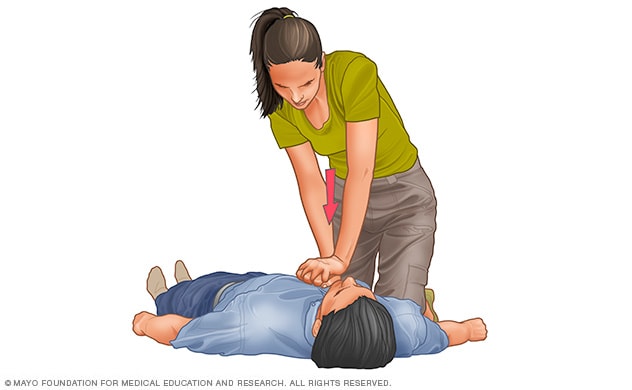
  • Place the heel of one hand over the center of the person's chest, between the nipples. Place your other hand on top of the first hand. Keep your elbows straight and position your shoulders directly above your hands.
  • Use your upper body weight (not just your arms) as you push straight down on (compress) the chest at least 2.5 inches (approximately 5 centimeters). Push hard at a rate of 100 to 120 compression a minute.
  • If you haven't been trained in CPR, continue chest compression until there are signs of movement or until emergency medical personnel take over. If you have been trained in CPR, go on to opening the airway and rescue breathing.


Chest compressions


4. AIRWAY
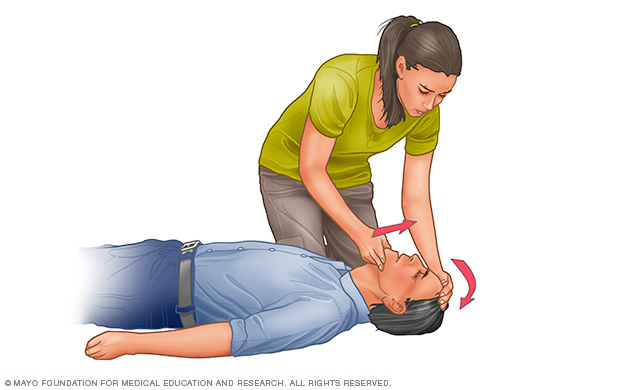
  • If you're trained in CPR and you've performed 30 chest compression, open the person's airway using the head-tilt, chin-lift maneuver
  • Put your palm on the person's forehead and gently tilt the head back. Then with the other hand, gently lift the chin forward to open the airway.


Airway being opened


5. BREATHING
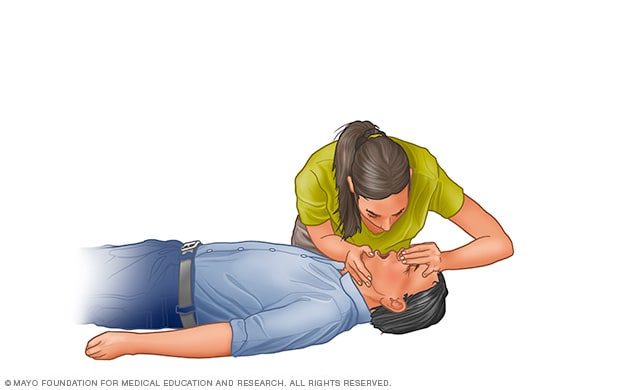
  • Rescue breathing can be mouth-to-mouth breathing or mouth-to-nose breathing if the mouth is seriously injured or can't be opened.
  • With the airway open (using the head-tilt, chin-lift maneuver), pinch the nostrils shut for mouth-to-mouth breathing and cover the person's mouth with yours, making a seal.
  • Prepare to give two rescue breaths. Give the first rescue breath — lasting one second — and watch to see if the chest rises. If it does rise, give the second breath. If the chest doesn't rise, repeat the head-tilt, chin-lift maneuver and then give the second breath. Thirty chest compressions followed by two rescue breaths is considered one cycle. Be careful not to provide too many breaths or to breathe with too much force.
  • Resume chest compressions to restore circulation.
  • As soon as an automated external defibrillator (AED) is available, apply it and follow the prompts. Administer one shock, then resume CPR — starting with chest compressions — for two more minutes before administering a second shock. If you're not trained to use an AED, a 911 or other emergency medical operator may be able to guide you in its use. If an AED isn't available, go to step 5 below.
  • Continue CPR until there are signs of movement or emergency medical personnel take over.
Rescue breathing

NOTE
  • If there is sign of life (Eg: coughing), please check breathing and place the casualty into recovery position. 
  • Check vital signs (pulse and breathing) every 3 to 5 minutes.

Cardio-Pulmonary Resuscitation (CPR) - Part 1: Introduction

Cardio-Pulmonary Resuscitation (CPR) - Part 1: Introduction CARDIO-PULMONARY RESUSCITATION (CPR) Cardio-Pulmonary Resuscitation (CPR...