Showing posts with label First Aid. Show all posts

Wednesday, March 27, 2019

Cardio-Pulmonary Resuscitation (CPR) - Part 1: Introduction

Cardio-Pulmonary Resuscitation (CPR) - Part 1: Introduction


CARDIO-PULMONARY RESUSCITATION (CPR)
Cardio-Pulmonary Resuscitation (CPR) is a lifesaving technique useful in many emergencies, including a heart attack or near drowning, in which someone's breathing or heartbeat has stopped.
「cpr」的圖片搜尋結果


WHY SHOULD EVERYONE LEARN CPR?
Acute heart disease causing unexpected heart arrest is the most frequent single killer in our society. In addition, breathing and heart arrest are the immediate causes of dearth in a large number of accidents.

Substantial proportion of these deaths could be prevented if:

  • Cardio-Pulmonary Resuscitation (CPR) is started immediately by a trained bystander in order to preserve vital functions
  • Emergency medical treatment becomes quickly available in order to restore spontaneous heartbeat and breathing
Although qualified medical personnel may be on the spot relatively early, their efforts are too often in vain as nobody has been providing basic life support during the very first and most crucial minutes.

So that a trained bystander is available to perform CPR when arrest occurs, as many as possible of the teachable population should be motivated and trained to perform the relatively simple techniques of CPR.

WHY SHOULD YOU LEARN CPR?
Perhaps some one you love is suffering from heart disease. Maybe the nature of your job requires that you prepared to handle medical emergencies. Or you may believe, as many people do, that knowing the skills of CPR simply makes you a more useful member of  your community.

Whatever your reasons, it is important to remember that CPR can help to save lives. Your hard work and study can make a difference.

LEGAL CONSIDERATIONS IN USA
Recognition is given for successful completion of a CPR course, which includes passing written and performance examinations based on criteria established by the the American Heart Association. It does not imply licensure or warrant future performance.

There was no instance known which a layperson that has performed CPR has been sued successfully. There are 'Good Samaritan' Laws in many states that specifically protect professionals and laypersons performing CPR 'in good faith'. Under most Good Samaritan Laws, laypersons are protected if they performed CPR even if there have no formal training.

All the citizens who are able to learn and perform CPR, if such performance would not pose a medical or psycho-emotional danger to themselves, should learn to perform CPR well enough to sustain the life of the victim until professional emergency medical treatment becomes available.

As a rescuer acting a good faith, you should remember that one CPR is begun, you may stop only when:
  • The victim recovers (regains breathing or movement)
  • Another trained individual takes over
  • You are too exhausted to continue
COMMON CAUSES OF SUDDEN DEATH
  • Cardiac Arrest
  • Electric Shock
  • Drowning
  • Drug Overdose / Drug Abuse
  • Suffocation
  • Severe Allergic Reaction
  • Trauma
  • Stroke

Thursday, March 14, 2019

Cardio-Pulmonary Resuscitation (CPR) - Part 2: CPR for an adult

Cardio-Pulmonary Resuscitation (CPR) - Part 2: CPR for an adult


It's far better to do something than to do nothing at all if you are fearful that your knowledge or abilities are not sufficient enough. Remember, the difference between your doing something and doing nothing could be someone's life.

Here is advice from the American Heart Association:

  • Untrained. If you are not trained in CPR, then provided hands-only CPR. That means uninterrupted chest compression of 100 to 120 a minute until the paramedics arrive. You don't need to try rescue breathing.
  • Trained and ready to do so. If you're well-trained and confident in your ability, check to see if there is a pulse and breathing. If there is a pulse and breathing. If there is no breathing or pulse within 10 seconds, begin chest compression. Start CPR with 30 chest compression before giving two rescue breaths.
  • Trained but rusty. If you have previously received CPR training but you are not confident in your abilities, then just do chest compression at a rate of 100 to 120 a minute.
The above advice applies to adults, children and infants needing CPR, but not newborns (infants up to 4 weeks old).

CPR can keep oxygenated blood flowing to the brain and other vital organs until more definitive medical treatment can restore a normal heart rhythm.

When the heart stops, the lack of oxygenated blood can cause brain damage in only a few minutes. A person may die within 8 to 10 minutes.

To learn CPR properly, take an accredited first-aid training course, including CPR and how to use an Automated External Defibrillator (AED). If you are untrained and have immediate access to a phone, call 911 or your local emergency number before beginning CPR. The dispatcher can instruct you in the proper procedures until help arrives.

CPR GUARD LINE 2010

  • A compression rate of at least 100 per min
  • At least 5 cm (2.5 inch) for chest compression depth
  • Push hard and fast
  • Chest must fully recoil before next compression
  • One complete cycle: 30 chest compression to 2 rescue breath
  • Each ventilation must over 1 second, just enough to see chest rise
  • Call for help
STEPS TO DO CPR 
  1. Danger
  2. Response
  3. Compression / Circulation
  4. Airway
  5. Breathing
1. DANGER
  • Before doing CPR, we must make sure that surrounding are safe and no danger will harm the casualty.
  • Ask for help (Call 990 for the ambulance)
2. RESPONSE
  • Check for the casualty's response to command, touch and pain
  • Casualty may response by eye movement, movement or show verbal response
  • The level of responsiveness (Conscious to Unconscious):-
    • Alert
    • Voice 
    • Pain
    • Unconscious
  • If the casualty is unconscious, start the chest compression.
3. COMPRESSION
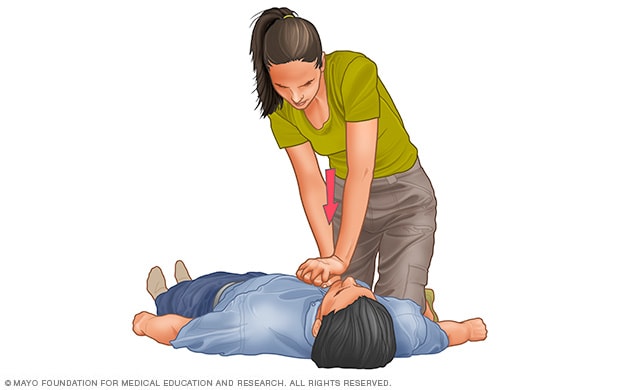
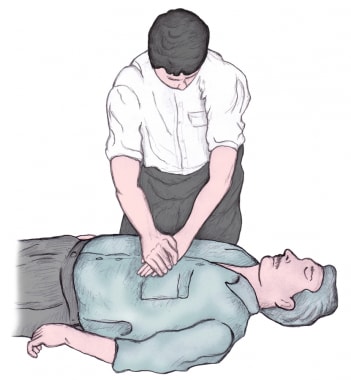
  • Put the person on his or her back on a firm surface.
  • Kneel next to the person's neck and shoulders.
  • Place the heel of one hand over the center of the person's chest, between the nipples. Place your other hand on top of the first hand. Keep your elbows straight and position your shoulders directly above your hands.
  • Use your upper body weight (not just your arms) as you push straight down on (compress) the chest at least 2.5 inches (approximately 5 centimeters). Push hard at a rate of 100 to 120 compression a minute.
  • If you haven't been trained in CPR, continue chest compression until there are signs of movement or until emergency medical personnel take over. If you have been trained in CPR, go on to opening the airway and rescue breathing.


Chest compressions


4. AIRWAY
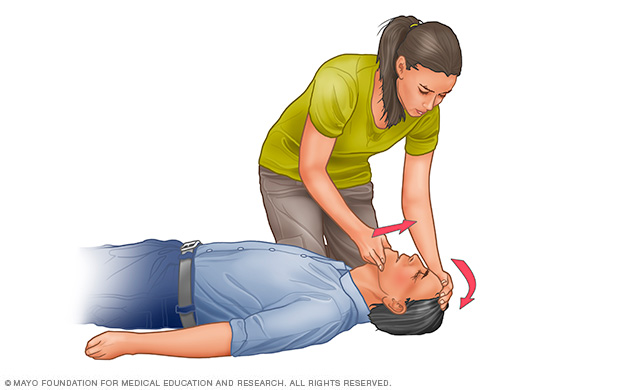
  • If you're trained in CPR and you've performed 30 chest compression, open the person's airway using the head-tilt, chin-lift maneuver. 
  • Put your palm on the person's forehead and gently tilt the head back. Then with the other hand, gently lift the chin forward to open the airway.


Airway being opened


5. BREATHING
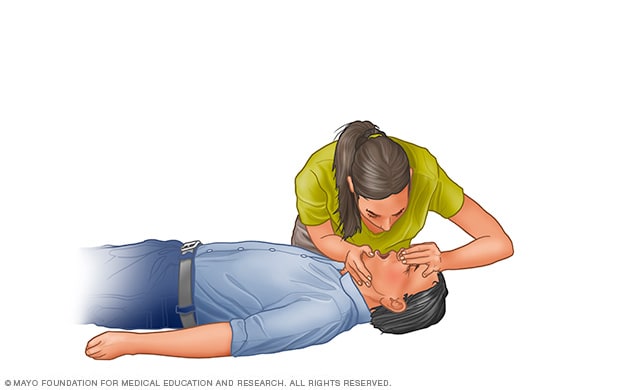
  • Rescue breathing can be mouth-to-mouth breathing or mouth-to-nose breathing if the mouth is seriously injured or can't be opened.
  • With the airway open (using the head-tilt, chin-lift maneuver), pinch the nostrils shut for mouth-to-mouth breathing and cover the person's mouth with yours, making a seal.
  • Prepare to give two rescue breaths. Give the first rescue breath — lasting one second — and watch to see if the chest rises. If it does rise, give the second breath. If the chest doesn't rise, repeat the head-tilt, chin-lift maneuver and then give the second breath. Thirty chest compressions followed by two rescue breaths is considered one cycle. Be careful not to provide too many breaths or to breathe with too much force.
  • Resume chest compressions to restore circulation.
  • As soon as an automated external defibrillator (AED) is available, apply it and follow the prompts. Administer one shock, then resume CPR — starting with chest compressions — for two more minutes before administering a second shock. If you're not trained to use an AED, a 911 or other emergency medical operator may be able to guide you in its use. If an AED isn't available, go to step 5 below.
  • Continue CPR until there are signs of movement or emergency medical personnel take over.
Rescue breathing

NOTE
  • If there is sign of life (Eg: coughing), please check breathing and place the casualty into recovery position. 
  • Check vital signs (pulse and breathing) every 3 to 5 minutes.

First Aid Kit (Part 1)

First Aid Kit (Part 1)


FIRST AID KIT
  • All workplaces, leisure centers, cars and homes should have first aid kits.
  • First aid kits for workplaces or public places must conform to legal requirements and be clearly marked in a white box with a green cross or a red box with a white cross and easily accessible.
  • Home is the place that we often spend our time other than our workplaces, officers and other venues.
  • Many unwanted accidents happened in our home due to our carelessness. For example, we accidentally cut our fingers when preparing meal in kitchen.
  • So, there is a must for us to prepare a first aid kit in home for our own safety. If any accidents happened, we can use the content in first aid kit to treat our wound to prevent the situation from deteriorating.
  • We can actually buy a kit or put together first aid items by ourselves and keep those first aid items in a clean, waterproof container.
  • Any first aid kit must be kept in a dry place, and checked and replenished regularly.
  • We can also add pain-relief tablets such as paracetamol in first aid kit


「first aid kit」的圖片搜尋結果

CONTENT OF FIRST AID KIT
  1. Yellow solution
  2. Savlon
  3. Adhesive dressings / plasters
  4. Triangular bandage
  5. Crepe bandage
  6. Roller bandage
  7. Cotton Ball
  8. Gauze pad
  9. Disposable gloves
  10. Forceps
  11. Scissors

First Aid Kit (Part 2) - Function of First Aid Materials

First Aid Kit (Part 2) - Function of First Aid Materials


FUNCTION OF FIRST AID MATERIALS

1. Yellow Lotion / Iodine Lotion
  • Protect wounds from inflection and promote recovery 
  • Apply after Salvon 
「yellow lotion」的圖片搜尋結果

2. Salvon
  • Kill the germs and bacteria on the wounds / injured parts
  • Wounds / injure parts must be cleaned first before applying Salvo
「savlon」的圖片搜尋結果

3. Adhesive dressings / plasters
  • Made up of fabric or waterproof plastic
  • Are applied to small cuts and grazes
  • REMINDER: Use hypoallergenic plasters for anyone who is allergic to the regular adhesive plasters
  • People who work with food are required to use blue plasters
  • Special gel plasters can protect blisters
「clear plasters」的圖片搜尋結果
Clear Plasters
「blue catering plasters」的圖片搜尋結果
Blue Catering Plasters

「gel blister plaster」的圖片搜尋結果
Gel Blister Plaster


4. Triangular bandage

  • Made of cloth or fabric
  • Standard measurement: 90 cm X 90 cm X 130 cm
  • Can be used folded as bandages or slings
「triangular bandage」的圖片搜尋結果

5. Roller bandages

  • Used to give support to injured joints / parts
  • Absorb fluid from injured parts (bleeding wound)

「roller bandages」的圖片搜尋結果


相關圖片


6. Crepe bandages

  • Used to give support to injured joints, secure dressings in place, maintain pressure on wounds and limit swelling
  • Mainly used to immobilize injured joints / parts (non-bleeding wound)

「crepe bandage」的圖片搜尋結果

相關圖片
7. Cotton balls / Gauze pads

  • Used as dressings or as swabs to clean around wounds
  • ONLY can be used once
「cotton ball」的圖片搜尋結果
Cotton balls
「gauze pad」的圖片搜尋結果
Gauze pads
8. Disposable gloves
  • Wear gloves, if available, whenever you dress wounds or when you handle body fluids or waste materials
  • Purpose: to prevent inflection
  • REMINDER: Use latex-free gloves because some people are allergic to latex
  • ONLY can be used once
「disposable gloves」的圖片搜尋結果


Stroke

Stroke

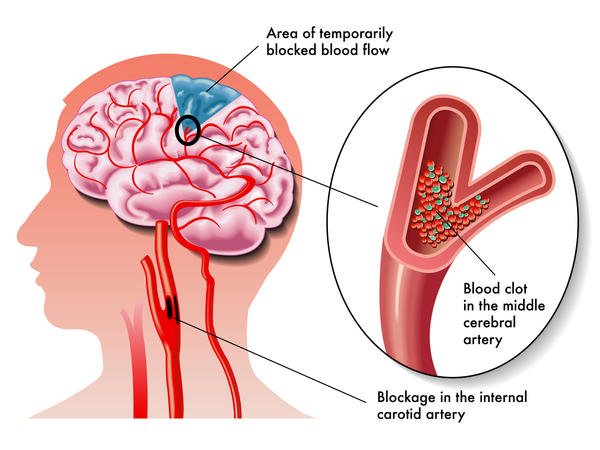
A stroke or brain attack is a medical emergency that occurs when the blood supply to the brain is disrupted. Strokes are the third most common cause of death in Malaysia and many people live with long-term disability as a result of a stroke. This condition is more common later in life and is more common later in life and is associated with disorders of the circulatory system, such as high blood pressure.

The majority of strokes are caused by a clot in a blood vessel that blocks the flow of blood to part of the brain. However, some strokes are the result of a ruptured blood vessel that causes bleeding into the brain. If a stroke is due to a blood clot, it may brain and improve recovery.

CAUSES OF STROKE
1. Cerebral Thrombosis
  • Blockage in arteries supplying oxygenated blood will result in damage to affected parts of the brain
相關圖片

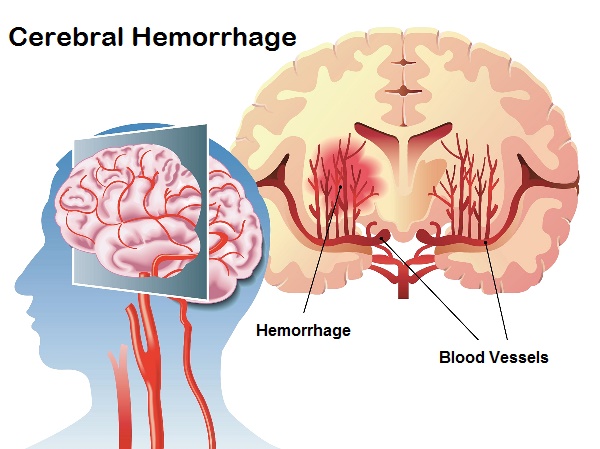
2. Cerebral Haemorrhage

  • A weakened area of an artery ruptures. This results in an area of the brain being deprived of oxygenated blood and pooling of blood causing increased pressure on the brain, displacing tissues and interfecting with function. Cerebral haemorrhage is often associated with arteriosclerosis and hypertension.
「Cerebral Haemorrhage」的圖片搜尋結果


SYMPTOMS AND SIGNS
  • Headache
  • Confusion / dizziness
  • Loss of function or paralysis of extremities (usually on one side of body)
  • Numbness (usually limited to one side of body)
  • Collapse
  • Facial flaccidness and loss of expression (often to one side of face0
  • Impaired speech
  • Unequal pupil size
  • Impaired version
  • Rapid, full pulse
  • Difficult breathing, snoring
  • Nausea
  • Convulsions
  • Coma
  • Loss of bladder and bowel control
EMERGENCY CARE OF STROKE PATIENT
  • Maintain open airway
  • Minimize brain damage
  • Arrange urgent removal to hospital as soon as possible
WHAT TO DO
  1. Look the casualty's face. Ask him to smile: if he has had a stroke he may only be able to smile on one side - the other side of his mouth may droop.
  2. Ask the casualty to raise both his arms: if he has had a stroke, he may only be able to lift one arm.
  3. Find out whether the person can speak clearly and understand what you say. When you ask a question does he respond appropriately.
  4. Call 999 for emergency help and tell ambulance control that you have used the FAST guide and you suspect a stroke.
  5. Keep the casualty comfortable and supported. If the casualty is conscious, you can help him to lie down. Reassure him that help is on its way.
  6. Regularly monitor and record vital signs - breathing, pulse and level of response while waiting for help to arrive. Do not give the casualty anything to eat or drink because it may be difficult for him to swallow.
FAST (Face-Arm-Speech-Time)
Use the FAST (Face-Arm-Speech-Time) guide if you suspect a casualty had a stroke:
Face weakness : the casualty is unable to smile evenly and the mouth or eye may be droopy
Arm weakness : the casualty is only able to raise one of his arms  
Speech problems : the casualty is unable to speak clearly or may not understand the spoken word
Time to call 999 for emergency help if you suspect that the casualty has had a stroke


MANAGEMENT
Conscious Patient

  • Lay casualty downs with head and shoulder slightly raised
  • Incline head to one side
  • Place towel to absorb any dribbling
  • Keep patient calm
  • Administer high concentration of oxygen
  • Monitor vital signs
  • Loosen constricting clothing that might interfere with breathing
  • Transport in semi-reclined position
  • Give nothing by mouth
  • Treat for shock
  • Sit in front of patient, keep eye contact and speak slowly and clearly
Unconscious Patient
  • Maintain open airway
  • Check breathing, pulse and level of responsiveness
  • Resuscitate if necessary
  • Provide high concentration of oxygen
  • Monitor vital signs
  • Transport in lateral recovery position
  • Keep affected limbs underneath patient, use protective padding

Burns and Scalds

Burns and Scalds

These are injuries caused by extremes of temperatures (heat or cold), chemicals or radiation. Burns caused by 'moist' heat such as steam or hot liquids are called scalds.

CAUSES OF BURNS AND SCALDS
A burn is caused by:
  • Dry heat (fire or hot objects)
  • Electrical burn (contact with electrical current or by lightning)
  • Friction (from a revolving wheel or fast moving rope)
  • Chemical burn (strong acids or alkalis)
  • Intense cold (liquid oxygen, liquid nitrogen and extremely cold metals)
  • Radiation (exposure to sun or radioactive substances)
A scald is caused by:
  • Moist heat (hot liquid or steam)

EXTENT OF BURNS
The Rule of Nines
  • The diagram divides the body surface into areas of nine percent. Any injury of an equivalent area will require hospital treatment. Any burn larger than 2 cm - 3 cm (1 inch) diameters requires medical attention.
「rules of nine」的圖片搜尋結果

LEVEL OF BURNS
「superficial burn」的圖片搜尋結果

Superficial burns (First Degree Burn)
  • These burns involve only the outer layers of skin and results in general redness, swelling and extreme tenderness. This type of burn usually heals well.
Intermediate burns (Second Degree Burn)
  • These burns involve the formation blisters which may be intact of broken with an area of surrounding redness. Intermediate burns may become infected so you should seek medical aid.
Deep burns (Third Degree Burn)
  • These burns involve all layers of skin. The skin may be appearing pale, waxy and sometimes charred. Because the nerve-endings are damaged, these burns are relatively pain-free. Deep burns always require medical attention.

SYMPTOMS AND SIGNS
  • Severe pain at the injury
  • Reddening of the skin
  • Sometimes blistering
  • There may be destruction of skin (charring)
  • Shock
WHAT TO DO
  1. Start cooling the injury as soon as possible. Flood the burn with plenty of cold water but do not delay the casualty's removal to hospital. Help the casualty to sit or lie down. If possible, try to prevent the burnt area from coming into contact with the ground to keep the burn as clean as possible.
  2. Call 999 for emergency help. If possible, get someone to do this while you continue cooling the burn.
  3. Continue cooling the affected area for at least 10 minutes or until the pain is relieved. Watch for signs of breathing difficulty. Do not over-cool the casualty because you may lower the body temperature to a dangerous level, causing hypothermia. This is a particular hazard for babies and elderly people.
  4. Do not touch or otherwise interfere with burn. Gently remove any rings, watches, belts, shoes and burnt or smouldering clothing before the tissues begin to swell. A helper can do this while you are cooling the burn. A helper can do this while you are cooling the burn. Do not remove any clotthing that is stuck to the burn.
  5. When the burn is cooled, cover the injured area with kitchen film to protect it from infection. Discard the first two turns from the roll and then apply it lengthways over the burn. A clean plastic bag can be used to cover a hand or foot; secure it with a bandage or adhesive tape applied over the plastic, not the damaged skin. If there is no plastic film avaible, use a sterile dressing or improvise with non-fluffy material, such as a folded triangular bandage.
  6. Reassure the casualty and treat him for shock if necessary. Record details of the casualty's injuries. Monitor and record his vital signs - breathing, pulse and level of response while waiting for help to arrive.
CAUTION
  • Do not remove anything sticking to the burn; you may cause further damage and introduce inflection into the burnt area
  • Do not burst any blisters
  • Do not apply any type of lotion or ointment to the burnt area: it may damage tissues and increase the risk of inflection
  • The use of specialised dressings, sprays and gels to cool burns is not recommended
  • Do not use adhesive dressings or apply adhesive tape to the skin; a burn may be more extensive than it first appears
  • If the casualty has a burn on his face, do not cover the injury; you could cause the casualty distress and obstruct the airway.
  • Do not allow the casualty to eat or drink because he may need an anaesthetic

Cardio-Pulmonary Resuscitation (CPR) - Part 1: Introduction

Cardio-Pulmonary Resuscitation (CPR) - Part 1: Introduction CARDIO-PULMONARY RESUSCITATION (CPR) Cardio-Pulmonary Resuscitation (CPR...